In this post, I want to share my experience with the Red Sea Max Nano (now branded G2 Cube) reef tank. I have been maintaining it at home for the past six years.
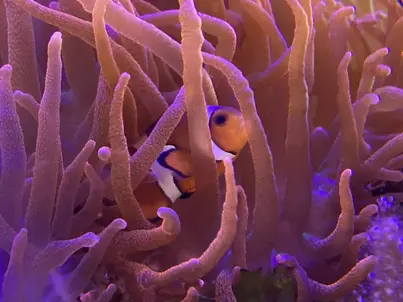 Clownfish living rent-free at my place
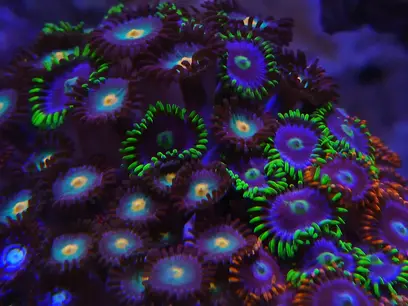 Zoanthids living rent-free at my place
Where it all started
I signed up for scuba diving back in 2016. It represented a challenge for me: I wanted to get out of my comfort zone, learn new skills, meet other travellers, and discover marine life. I took the PADI Open Water training and got certified within three days. My initial expectations were quickly met: I learnt about gear management, breathing techniques, buoyancy control, etc. I also met other international enthusiasts who were as excited as me to take the course.
Most importantly, I fell in love with the ocean. I thought the certificate would be the finish line, but in fact it was the starting gate of a fascinating underwater journey!
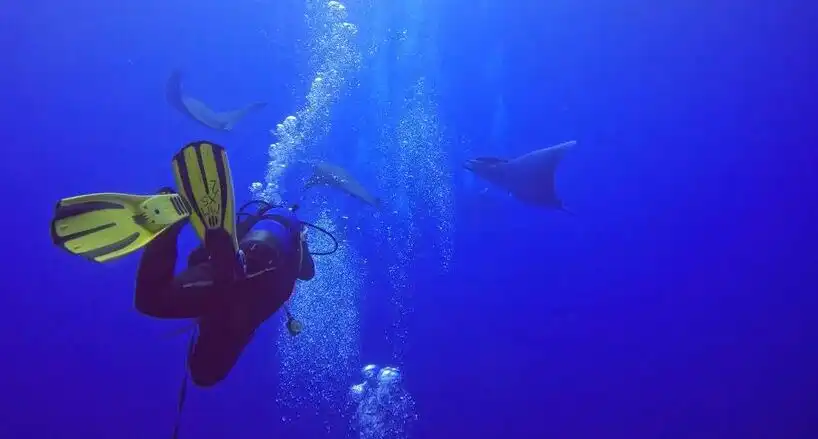 Diving with Devil Rays, Santa Maria Island, The Azores
The problem was that the journey only happened when I was on a plane, on a boat, or on a one-hour drive to the dive site. In between, the water was just a screen saver. I wanted the movement and the slow blue light and the small lives going about their business in a place I could see every day, not only when the tank was full and the season was right.
A home reef was the obvious answer.
I chose the Nano for practical reasons
Budget first. I quickly realised that reef keeping is an expensive hobby if you want to make it right. I simply couldn’t afford a large system. Buying used equipment could have been a possibility, but would have increased the risk of failure.
The second reason was rent. I was living in a temporary apartment on a short lease so I had to make sure a new aquarium could be moved easily. An all-in-one system that fits in a 45cm cube turned out to be a good choice. In fact I have moved three times since then and the system is still intact! I only had to take the water out and use some help for carrying it carefully. Handling a larger reef tank would have been much, much harder.
What the Nano does well
It is truly plug-and-play, as advertised. Red Sea fulfills their promise: the only configuration required is the lighting schedule of the ReefLED that must be set from the ReefBeat app through WiFi. The machinery at the back (filter bag, skimmer, circulation pump and top-off reservoir) is satisfyingly easy to assemble. Each part is also fast to remove for maintenance (provided there is enough free space around the tank) with the exception of the circulation pump for which the eyeball nozzle can be tricky to attach and detach.
The tank (without the consumable parts) ages well. After six years, it still looks new: glass is clear, and joints are undamaged. The only age-related injury I could notice is the black plastic cover behind the rotatable rear sump screen which started to decay. This caused the screen to slowly become transparent here and there. It is however barely visible, and I added transparent tape to stop (or at least slow down) the degradation.
Finally, it fits well in the room. I bought the Nano along with the white cabinet underneath. To this day, I am still happy with how it looks, and how much space I have in it.
What the Nano does less well
Despite being sold as an ‘all-in-one’ system, there is not enough equipment to run a successful tank. In fact a crucial part is missing: the heater. Although Red Sea’s user manual recommends to monitor temperature and keep it stable, it doesn’t explain how. It implicitly tells you to rely on room temperature, which I find to be bad advice (in my experience). A system advertised as ‘all-in-one’ should include a heater to reliably and autonomously regulate the temperature of the tank. If it can get hot in the room, an aquarium cooling fan can also be useful.
The same remark applies for the cover net. Believe it or not, some of your animals will try to get out of the water. I find it shameful that cover nets are not even mentioned in the user manual. If you don’t get one, you will eventually regret it.
Regarding the pumps and the skimmer, unfortunately they are hard to find as spare parts, at least in Belgium. This led me to switch to non Red Sea products (see upgrades below).
Finally, the white cabinet is an awesome feature, but it doesn’t include shelves. I had to add them myself.
My recommended upgrades
The following is a list of upgrades I brought to the system. With the exception of the heater and the cover net, I’d say they are all optional. However they will all contribute to making livestock happy and maintenance painless.
- A heater. As discussed above, a heater is mandatory for autonomous water temperature regulation. I added a 75W EHEIM electronic aquarium heater between the skimmer and the filter bag. During maintenance, I can easily check that it is working by lifting it a few centimeters and inspecting the LED status.
- A temperature sensor. In addition to checking the heater, I measure my water temperature using a temperature sensor mounted on the glass. It’s an adhesive LED display I bought off AliExpress from MINYUE. I placed it near the circulation pump nozzle.
- A cover net. To prevent animals from conquering my room, I have added an official Red Sea cover net that I bought at my local fish store. Assembly was not straightforward and required tools, but it’s worth the effort. Cheaper solutions probably exist but I can recommend this one.
- An automatic feeder with a floating feeding ring. Thanks to these guys, I never have to worry about feeding. They take care of it everyday— even when I am away for a week or two. The feeder shows its battery status all the time, so I always know when to replace it. To avoid overfeeding, I reduced the size of the hole where the food exits the feeder by partially covering it with some tape. I feed my fish once a day near the circulation pump nozzle.
- An automatic top-off system connected to a 20L RO water container inside the cabinet. They will take care of compensating for water evaporation. In other words, you don’t have to regularly add water to the reservoir at the back of the tank, they will do it for you. Big win! I found the Tunze Osmolator Nano 3152 to be a great solution for this (although the water pump is a bit noisy when it runs). It comes with a few components:
- a water level sensor: I placed it on the backside of my tank (on top of the circulation pump). It’s behind the rear sump screen so it is well hidden.
- a water pump: it is activated depending on water level sensor readings. I placed it inside a 20L water container (not included). The container is hidden inside my cabinet under the tank.
- a plastic tube: to deliver the pumped water to the tank. I placed its end close to the water level sensor.
- A new skimmer. I replaced the Nano skimmer with a Tunze Comline DOC Skimmer 9001. It’s easy to buy online, easy to plug, and runs smoothly.
- A new circulation pump. I replaced the Nano circulation pump with a Jebao pump DCS-1200. Just like the skimmer, it’s easy to buy online, easy to plug, and runs smoothly.
Tips and mistakes made
- Test your tank regularly, even if results seem to never change. After ten weeks of same results, I started to test less because I felt it was useless. I stopped testing for months, only to notice after that some parameters had drifted. It had little impact on the tank, but it could have been avoided. Test your tank regularly.
- Invest in spare parts. It’s worth anticipating equipment malfunction, especially on days when stores are closed.
- Add easy, beginner-friendly livestock. It’s tempting to add fancy hard corals, but they don’t belong in a nano tank— water parameters fluctuate much more than in a larger tank, even with the right amount of added water flow.
- Protect electrical components at all costs. I killed a tank because I didn’t protect a power strip well enough. I thought using a towel was enough to protect from water drops when manipulating equipment. It turned out I had spilled much more and a short circuit happened only after I left my place. When I came back, the tank was a cemetery. Protect electrical components at all costs.
- Address abnormal observations immediately. I let Aiptasia take over my tank over a few weeks and it killed some of my corals.
- I tried using dosing pumps with the Nano. The objective was to get my hands dirty with this kind of equipment so that I would be comfortable using them on a larger tank in the future. I don’t recommend using them for this reason. Dosing pumps are cool, but just wanting them is not enough. The tank should actually need them, i.e. livestock should consume the added chemicals at sufficiently high rate. Otherwise, the pumps will end up unplugged. I thought that low consumption would be still enough to justify dosing, but it was too close to zero with the regular water changes.
Is the Nano for you?
For six years, the Red Sea Max Nano has done the one thing I actually asked of it: it has been there, blue and moving, on a white cabinet, every single morning when I pour my coffee. If like me, you want the ocean in a place you can see every day without a plane ticket, and you are willing to learn the small maintenance routines and accept that some of your ideas will not work in 75 litres, then yes. It is for you.
It is not for you if
- you think it will relax you (it will most but not all the time),
- you want to grow sensitive livestock (then buy a larger tank),
- you don’t want to take care of it,
- you can’t stand failure.
I hope this post was useful to get you decided!
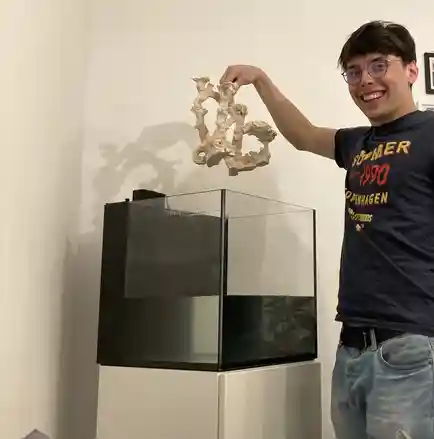 Starting my second tank
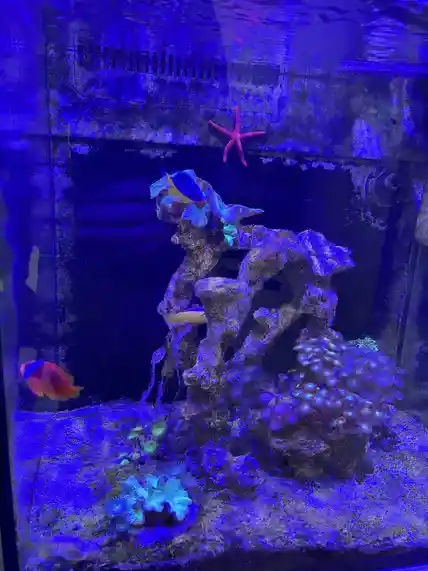 My current second tank